Guilford Board Extends Freeman's Contract to 2029
Guilford's Board of Education extended Superintendent Freeman's contract through June 2029 and approved a 3.25 percent raise for 2026-27.
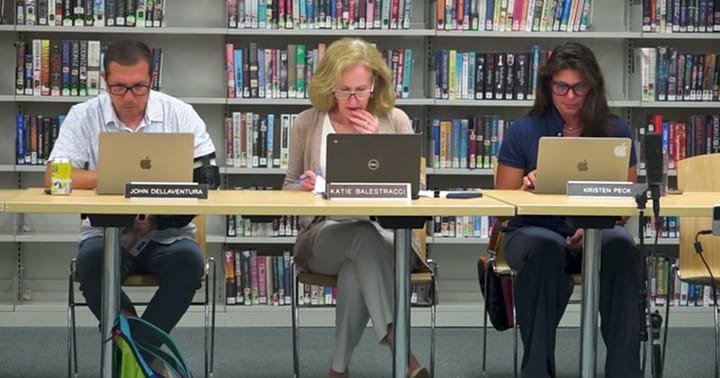
Board of Education · Meeting of August 10, 2026
Guilford's Board of Education extended Superintendent Freeman's contract through June 2029 and approved a 3.25 percent raise for 2026-27. The board also approved $1,045,500 in budget transfers to cover fiscal 2025-26 overspending on electricity, medical benefits and building upkeep, funded largely by a $835,000 surplus in the tuition line. It further directed $302,531.96 in unspent funds to the district's non-lapsing account and recommended the town send $300,000 to the shared municipal medical fund.
Resident Nathan Jacobson of 1470 Long Hill Road told the board he remains concerned that Guilford High School's use of out-of-school suspension may not meet the "serious disruption" threshold set by Connecticut General Statutes 10-233C, saying "my question is not simply whether the district believes it is compliant." The board took no action on his concerns before moving into executive session on pending litigation.
In the full story:
- Who Was There
- Organizations And Documents Referenced
- The complete report — 2,855 words
Source: the Board of Education meeting of August 10, 2026, reported from the official video recording and transcript.
Checked against the record: before publication this article was automatically compared with the meeting transcript.
The Full Article
Minutes and Agenda Housekeeping
The board opened by approving minutes from its June 22 workshop and July 13 regular meeting, both delayed by the summer schedule. Members corrected a sentence misstating that "field boundaries" rather than school boundaries had declined slightly, struck an opening clause that had misattributed a DCF-tracking column to recent legislation, and fixed a mislabeled section heading. The July 13 minutes passed with members Kristen Peck, Jennifer Scoggin and Jennifer Baldwin abstaining, apparently because they were not present at the earlier meeting being approved. This is routine business and consumed about five minutes.
Public Comment Timing Dispute
Background and stakes: Resident Nathan Jacobson of 1470 Long Hill Road has corresponded with the board and Superintendent Freeman for roughly a year over Guilford High School's suspension practices. He sought to speak during the meeting's early "public comment on agenda topics" slot, arguing his concern touched on four listed items: communications, policy, operations and challenging behavior.
The question before the body: whether Jacobson's suspension concern was sufficiently tied to a specific item on the night's board agenda (item 9) to be heard early, or whether it belonged in the later open public comment period.
Substantive content: Balestracci, presiding, maintained that none of the five items under "9, board agenda" that night — personnel ratifications, the educator growth plan, the superintendent's contract, budget transfers and the unexpended-funds transfer — related to suspensions, challenging behavior or policy. She explained the board's practice of taking topic-specific comment before votes so the public can weigh in prior to any Section 9 vote, reserving general comment for the meeting's end.
The deliberation: Jacobson pushed back, saying "it seems pretty disrespectful" to be asked to wait given that challenging behavior, policy and communications appear elsewhere on the printed agenda he had downloaded. Balestracci held her position, telling him "none of those are on tonight's agenda" in the sense of being board agenda action items, and asked other members if they agreed; no member objected to her ruling.
Procedural steps and outcome: No vote was required; Jacobson agreed to return during general public comment later in the meeting.
Implications: The exchange illustrates how Guilford structures its agenda into action items versus general topics, a distinction likely to recur if Jacobson continues pressing his suspension concerns at future meetings.
Financial Reports for Two Fiscal Years
Background and stakes: Guilford Public Schools closes its books each July, requiring the board to review spending against the fiscal year just ended (2025-26) and the fiscal year just begun (2026-27).
The question before the body: whether to approve both sets of July financial reports.
Substantive content: Business Manager Linda Trudeau reported that fiscal 2025-26 ended with July expenditures of $503,553.08, representing 99.19 percent of budget compared with 99.79 percent the prior year. July revenue was $53,166.34, including $28,330.10 in tuition from New Haven Public Schools, a $19,500 Magnet Transportation Grant and $5,002 in state adult-education funds. The district's non-lapsing education account ended the year, with interest, at $152,383.75, and total warrants for the month reached $775,583.76.
For the new fiscal year 2026-27, July expenditures were $4,523,511.07, or 7.42 percent of budget versus 7.83 percent the prior year — a figure Trudeau attributed partly to three pay periods falling in July plus extended-school-year payments. Total warrants for the month were $2,235,034.74. Trudeau flagged that the monthly medical payment to the Town of Guilford rose by about $300,000, a pattern she said is likely to repeat every month this year; a board member confirmed medical costs have been "the big driver this year."
The deliberation: Both reports had already been reviewed in detail in the board's Operations Committee meeting held immediately before the full board session, so floor discussion was brief.
Procedural steps and outcome: Both reports passed on separate unanimous voice votes.
Implications: The medical cost trend flagged here directly foreshadows the board's later vote to direct $300,000 in unspent funds toward the shared town-school medical fund.
Superintendent's Report: Enrollment, Staffing and Facilities
Background and stakes: The board receives an informal enrollment and staffing update each August ahead of the official October 1 enrollment count, particularly important this year given staffing changes at the elementary level.
The question before the body: an informational update; no vote was taken.
Substantive content: Superintendent Freeman reported 1,079 students enrolled in kindergarten through grade 4, producing an average class size of 19.6, up from a recent range of 17.8 to 18.2. Kindergarten averages 16 students; grades 1 through 3 average 19; grade 4 averages 20. Freeman flagged five specific sections approaching the board's recommended class-size ceiling: three kindergarten sections at Melissa Jones Elementary School sitting at 19 each (versus 14 to 15 at other schools); two first-grade sections at Leete at 21; two second-grade sections at Cox at 22; three third-grade sections at Lakes in the low-to-mid 20s; and three fourth-grade sections at Jones at 22 to 23. Freeman said no section currently exceeds the board's recommended maximum, but several are close, and the district may add a kindergarten section at Jones — beyond the 11 sections budgeted this year — if two or three more students enroll.
On staffing, Freeman reported 7.8 certified vacancies districtwide, with four candidates scheduled for interviews this week that should narrow the number to 3.8, including a partial art position and a long-term English substitute role at Guilford High School, a math position at Adams Middle School, and a special-education position likely at the Guilford Transition Academy.
Freeman also announced that a facilities meeting with consultant Fryer and Associates, originally scheduled for May, has been rescheduled for September 9 at 6:30 p.m. The meeting will present the district's completed 10-year facility maintenance study to the Board of Selectmen, Board of Finance, Board of Education and the Standing Building Committee, and will be recorded for later viewing.
Implications: The Jones kindergarten enrollment is the clearest near-term budget pressure point; Freeman said the principal is monitoring it "weekly, if not daily." The September 9 facility study presentation will set the stage for future capital planning across all four town boards.
Personnel Actions
The board ratified the resignation of Jamie Froelich, a grade 4 teacher at Calvin Leete Elementary School, effective July 13, 2026, and ratified the appointment of seven teachers: Kayla Dupree (science, Adams Middle School), Amy Dill (literacy coach, Calvin Leete Elementary), Heidi Ferrucci (special education pre-K, Guilford Lakes Elementary), Heidi Haslam (special education, Melissa Jones Elementary), Kyle Jones (special education, Baldwin Middle School), Marissa O'Connell (grade 4, Melissa Jones Elementary) and Carly Sorrentino (biology, Guilford High School). One board member asked why a literacy coach was being hired given recent budget cuts; Freeman explained the district eliminated three coaching positions this year — one coach moved into a principal role, one left for another district, and one specialist position was eliminated with the employee reassigned — but still needed to fill the literacy coach vacancy. Both personnel votes passed unanimously.
Educator Growth Plan
Background and stakes: State law now requires the board to annually approve its educator growth plan, which replaced the district's prior teacher supervision and evaluation system roughly two years ago.
Substantive content: Freeman told the board the plan is unchanged in substance this year, though several forms were revised based on teacher feedback. He noted the plan has been used by the state as an exemplar for other districts and was presented by district staff, including a colleague referred to as Dr. Goss, at the National Learning Forward Conference.
Procedural steps and outcome: Approved unanimously, with the board noting this will now be a standing annual agenda item.
Superintendent's Contract Extension and Compensation
Background and stakes: Freeman operates under a rolling three-year contract. Each year the board negotiates compensation for the coming year and votes separately on extending the contract by one year to maintain the three-year term. The evaluation process this year followed a contentious spring budget cycle that included two failed referenda before passage.
The question before the body: whether to approve a 3.25 percent compensation increase for 2026-27, retroactive to July 1, and whether to extend Freeman's contract through June 2029.
Substantive content: Balestracci said the raise aligns with the administrative increase applied districtwide this year and will apply to Freeman's base salary and tax-sheltered annuity. She described an unusually intense evaluation process this year, conducted over two extended executive-session evenings, calling it "the most intense conversation that we've had as a board" with Freeman in her fourth year on the board. Board members credited Freeman's "creative solutions" for limiting the impact of budget reductions directed by the Board of Finance, language echoed in a written statement from absent member Ralph Brooks, who wrote that the district "fared well by comparison" with other Connecticut districts despite a difficult budget year, while adding he remained "disappointed and frustrated with the year's budget approval process."
The deliberation: One board member, describing her first year on the board and her service on the superintendent search committee, said she remained "impressed" by Freeman's "level of enthusiasm and excitement over all decisions, big and small." Another member reflected that no school district has returned to its pre-pandemic normal, calling the post-COVID teaching environment "so different" and praising Freeman's navigation of it, while noting the evaluation conversation "could get a little tense" at times but remained productive.
Procedural steps and outcome: The board voted first to approve the 3.25 percent compensation increase, then separately voted to extend Freeman's contract from July 2026 through June 2029. Both votes passed unanimously among members present; Brooks, absent, stated in his letter that he would have voted yes on both items.
Implications: The extension commits the district to Freeman's leadership and the new compensation rate through the 2028-29 school year, locking in a known cost as the district continues working through recent budget reductions.
Budget Transfers to Close Fiscal 2025-26
Background and stakes: State law requires the district to end each fiscal year without exceeding any individual budget line, creating a statutory need for year-end transfers between lines.
Substantive content: Based on a proposal from Business Manager Linda Trudeau, reviewed in advance by the Operations Committee, the board approved $1,045,500 in transfers covering: $86,000 to employee medical benefits, $429,000 to purchased services/electricity, $174,000 to safety, sanitation and building upkeep, $51,500 to instructional capital equipment, $199,000 to site improvements, and $106,000 to special education transportation. The funds came from a $835,000 surplus in the tuition line, $100,500 from textbook supplies, and $110,000 from building and teaching supplies.
The deliberation: Balestracci noted the direction of the transfers was "unusual" this year because the tuition line — typically volatile due to out-of-district special-education placements — produced savings rather than requiring additional funds, a reversal of the district's more common pattern.
Procedural steps and outcome: Approved unanimously with no recorded discussion beyond Balestracci's explanation.
Transfer of Unexpended Funds
Background and stakes: After the above transfers, the district still ended fiscal 2025-26 with unspent money, again driven largely by tuition-line savings, at a level Balestracci said was unusually high compared with typical years.
Substantive content: The board voted to move $302,531.96 into the district's non-lapsing education account under Board Policy 3316, available for future educational needs not covered by the operating budget. Separately, the board voted to recommend that the Town of Guilford's Board of Finance direct the remaining $300,000 to the joint municipal medical fund used by both town and school employees — not directly to the town's general fund.
The deliberation: A board member clarified that the $300,000 recommendation goes to a central medical fund shared by both employers, not into town coffers generally, and that the Board of Finance retains final authority over where returned district funds are ultimately allocated. Members called the medical-fund earmark "the prudent thing to do, considering our recent medical experience," referencing the cost increases discussed earlier in the financial reports.
Procedural steps and outcome: Approved unanimously as a single motion covering both the non-lapsing transfer and the Board of Finance recommendation.
Implications: The decision ties directly to the medical cost increases flagged in the July financial reports, with the board attempting to direct one-time savings toward an anticipated recurring cost pressure.
Committee Reports
The Policy Committee had no report. The Operations Committee reported that the Facilities Department is completing multiple summer projects on schedule, thanked Linda Trudeau and the business office for year-end budgeting work, and said the committee discussed the impact of Connecticut's new free-breakfast-for-all-students legislation, which the district will continue monitoring as usage rises. No other standing committee or liaison had updates.
Public Comment on Suspension Practices
Background and stakes: Jacobson returned during general public comment to deliver the remarks he had deferred earlier. He said he has corresponded with the board and Freeman for nearly a year and submitted a letter to the board the day of the meeting outlining his concerns in full.
Substantive content: Jacobson argued that Connecticut General Statutes 10-233C limits out-of-school suspension to circumstances involving danger to persons or property or serious disruption of the educational process, and cited the Connecticut State Department of Education's "Guidelines for In-School and Out-of-School Suspensions" as reinforcing that OSS should be reserved for limited circumstances. He said he has heard from "multiple reliable sources" about students issued OSS during the 2025-26 school year for conduct that may not meet that statutory threshold, while acknowledging he lacks firsthand knowledge of specific incidents and is not asking the board to evaluate individual cases. His request was for the district to document how it verifies compliance, how administrators apply the "serious disruption" standard, and whether staff have received adequate training on the law.
The deliberation: Jacobson said Freeman has "repeatedly assured" him the district complies with state law, but that assurance alone no longer satisfies his concern after nearly a year of correspondence. No board member or administrator responded substantively on the record after his remarks.
Procedural steps and outcome: No motion or vote followed; the chair asked if anyone else wished to speak, and hearing none, moved to close public comment.
Implications: The board took no formal action on Jacobson's request. Whether a review of OSS practices occurs will depend on administrative follow-up outside the public meeting record reviewed here.
Executive Session
The board voted unanimously to enter executive session to discuss pending litigation and ongoing negotiations, inviting Superintendent Freeman along with outside attorneys identified as Stephen Murphy and Ken Weinstock. Balestracci stated that no further votes or discussion would occur publicly after executive session except a vote to adjourn.
WHO WAS THERE
Kathleen M.B. Balestracci — presided over the meeting; roster lists her as Chair, though the transcript does not use that title explicitly for this date. Kristen N. Peck — present; voted, including an abstention on the July 13 minutes. Jennifer G. Scoggin — present; voted, including an abstention on the July 13 minutes. Jennifer L. Baldwin — present; presented the July financial reports and voted, including an abstention on the July 13 minutes. John A. DellaVentura — presumed present based on roll-call votes; not individually quoted. Amy Fenollosa — presumed present based on roll-call votes; not individually quoted. Richard H. Hersh — presumed present based on roll-call votes; not individually quoted. Arnold F. Skretta — presumed present based on roll-call votes; not individually quoted. Ralph P. Brooks — absent; submitted a written statement read into the record endorsing the superintendent's compensation increase and contract extension. Superintendent Freeman — present; delivered the superintendent's report and participated in contract discussion. Linda Trudeau — business office; presented financial reports and the budget transfer proposal. Principal Wolowitz — referenced by Freeman as monitoring kindergarten enrollment at Melissa Jones Elementary School; not present or quoted directly. Dr. Goss — referenced by Freeman in connection with a national conference presentation on the educator growth plan; role and attendance unclear. Nathan Jacobson — resident of 1470 Long Hill Road; spoke twice during public comment regarding out-of-school suspension practices. Attorney Stephen Murphy — outside counsel invited into executive session for pending litigation and negotiations. Attorney Ken Weinstock — outside counsel invited into executive session for pending litigation and negotiations.
ORGANIZATIONS AND DOCUMENTS REFERENCED
Fryer and Associates — consultant that conducted the district's 10-year facility maintenance study, to be presented to multiple town boards September 9. Town of Guilford Board of Finance — directed the district's budget reductions this year; will decide whether to direct $300,000 in returned district funds to the shared medical fund. New Haven Public Schools — paid $28,330.10 in tuition reflected in the July 2025-26 financial report. Connecticut General Statutes 10-233C — cited by Nathan Jacobson as the statute limiting circumstances for out-of-school suspension. Connecticut State Department of Education, Guidelines for In-School and Out-of-School Suspensions — cited by Jacobson as further limiting appropriate use of OSS. Board Policy 3316 — governs the district's non-lapsing education account, invoked in the unexpended-funds transfer vote. National Learning Forward Conference — venue where district staff presented Guilford's educator growth plan as a state-recognized model. Standing Building Committee, Board of Selectmen, Board of Finance — invited, along with the Board of Education, to the September 9 facility study presentation.
Share this story
Know someone in Guilford who follows town government? Share Townbrief Guilford: they can sign up free.